 Advanced Nutrition Network
Hub
The Library
The sodium-potassium idea has a history. These are the people who built it, what they were working on, and where to read them in their own words.
Read the originals
Nutrition writing has a habit of presenting ideas as though they arrived last year. Most did not. The three below were working on mineral balance, vitamins, and hydration decades before any of it was fashionable.
This section introduces their work and points you to it. We do not hand down verdicts. Read them yourself and reach your own conclusions, which is what any of them would have wanted.
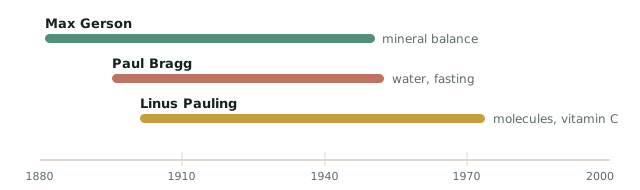
Max Gerson, 1881 to 1959
A German physician who trained in Germany, fled the Nazis, and practised in New York. His central observation was that the balance between sodium and potassium inside cells shapes how well the body functions, and he built an entire dietary approach around lowering one and flooding the other from food. That observation is the foundation of everything on this site.
He worked with fresh juices, saltless cooking, and a heavy load of produce at a time when none of that was standard practice. Albert Schweitzer thought highly of him. His book A Cancer Therapy: Results of Fifty Cases sets out his thinking in his own words, and the Gerson Institute continues to publish his material.
His saltless vegetable soup is still worth making.
Linus Pauling, 1901 to 1994
The only person to win two unshared Nobel Prizes. His work on the chemical bond and on molecular structure is foundational chemistry, and his campaigning against nuclear weapons testing won him the Peace Prize.
In his later decades he turned to what he called orthomolecular medicine, the idea that supplying the body with the right concentrations of substances already present in it could support health. His advocacy for vitamin C at high doses came out of that work and remains actively debated, with research into intravenous administration continuing today.
Vitamin C and the Common Cold and How to Live Longer and Feel Better are where to start. The Linus Pauling Institute at Oregon State University carries on research in the field.
Paul Bragg, 1895 to 1976
A health-food advocate who argued for fasting, distilled water, deep breathing, and vigorous daily movement long before any of it reached the mainstream. He opened one of the first health food stores in the United States and spent decades on the lecture circuit.
His case for distilled water is the direct ancestor of the argument on our water page. He put it plainly: water's job is to be clean, and minerals come from food. The Shocking Truth About Water and The Miracle of Fasting are his best-known books, both still in print and written to be read by anyone.
The distilled water question →
Guidance moves
Official nutrition advice has been revised repeatedly, most recently in January 2026 when the food pyramid was inverted. That history is worth knowing alongside these three.