 Advanced Nutrition Network
Water Distillers
As an Amazon Associate I earn from qualifying purchases. This costs you nothing extra. Everything recommended here is in daily use.
I distil my drinking water and have for years. It is the most contested piece of equipment in my kitchen and the one I get asked about most.
What distillation does
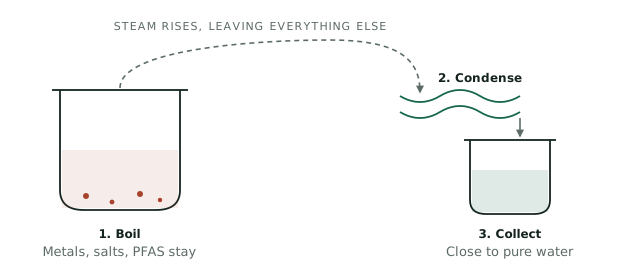
You boil water. The steam rises, leaving behind everything that cannot evaporate, then condenses back into liquid in a separate chamber. What you collect is close to pure water.
Left behind: heavy metals, fluoride, chlorine and its byproducts, nitrates, dissolved solids, bacteria, and PFAS, the forever chemicals most consumer filters handle poorly.
This is the most thorough purification available to a home kitchen, which is a description of the physics rather than a marketing claim. Nothing requiring a temperature above water's boiling point comes along.
The residue in the boiling chamber after a cycle is worth looking at once.
The mineral question
Distilled water contains no minerals, and there is a body of literature arguing that is a problem. A World Health Organization working paper raised concerns about demineralised drinking water, and epidemiological studies going back decades have found associations between soft, low-mineral water and cardiovascular mortality.
Here is how I think about it, and you should reach your own view.
The studies are observational. They compare soft-water regions with hard-water regions, and those places differ in diet, income, geology, and healthcare access.
Water is a minor mineral source. The calcium and magnesium in even quite hard tap water is a small fraction of what a decent diet delivers. Laboratory work has found animals given distilled water lifelong show no deficiencies, because their feed covers the requirement.
And this is the part that matters here: I do not ask my water to be a mineral supplement. I ask it to be clean. My potassium comes from coconut water, papaya, avocado, and steamed broccoli, which is the entire architecture of the reset.
Where the objection has force: if your diet is poor, water is one of the few mineral inputs you have. Fix the food first. The distiller is the last upgrade, not the first.
Against the alternatives
| Method | Removes | Misses |
|---|---|---|
| Pitcher filter | Chlorine, taste, some lead | Fluoride, most PFAS, nitrates |
| Reverse osmosis | Most contaminants including PFAS | Some VOCs, and wastes water |
| Distillation | Nearly everything non-volatile | Some VOCs without a carbon post-filter |
Reverse osmosis is the closest competitor and a legitimate choice. It needs plumbing, sends several gallons down the drain per gallon produced, and membranes fail silently.
Distillation's real advantage is that you can see it working. The scale in the chamber is the proof. No filter quietly failing behind a cabinet door.
Its real disadvantages: slow, roughly four to six hours per gallon. Uses electricity. Needs periodic descaling. Takes counter space.
What to look for
- Stainless steel boiling chamber. Avoid plastic in the chamber.
- Glass collection carafe rather than plastic.
- Activated carbon post-filter. Distillation carries over some volatile organics. Skip this and you have left a real gap.
- Automatic shutoff. It runs for hours and must stop on its own.
- An easy-to-descale chamber, wide enough to reach into.
Skip plastic chambers, units without automatic shutoff, and anything sold as an alkaline distiller. Distil, then remineralise separately if you want to.
How I use it
Distilled water is what I drink plain and what goes into coffee and tea. Coffee made with it tastes cleaner and there is never scale in the machine.
What I do not use it for is the potassium load. That comes from food. The distiller handles purity and the protocol handles minerals, and confusing the two jobs is where most of the argument about distilled water goes wrong.