 Advanced Nutrition Network
Guidelines
The Pyramid Turned Upside Down
On 7 January 2026 the USDA and HHS released the 2025–2030 Dietary Guidelines for Americans. The pyramid came back, and this time it is inverted.
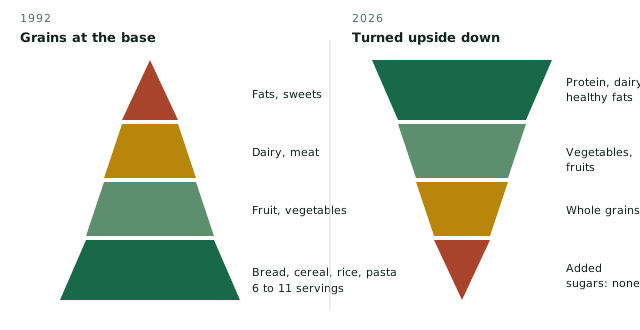
What the new pyramid says
The wide top, meaning eat most, now holds protein, dairy, and healthy fats alongside vegetables and fruits. Whole grains sit at the narrow bottom. MyPlate, the circular graphic that had guided Americans since 2011, has been retired.
The stated theme is "eat real food." Highly processed foods are named explicitly as something to avoid, which is a first for the guidelines. On added sugars the language is unusually firm: no amount is described as part of a healthy diet, and for children under four the recommendation is to avoid them altogether.
Meats, poultry, eggs, omega-3 seafood, nuts, seeds, full-fat dairy, olives, and avocados are all named as sources of healthy fats. Olive oil is highlighted as a preferred cooking fat. Butter and beef tallow appear alongside it.
What did not change
Despite the framing around ending a war on saturated fat, the guidelines keep the long-standing cap of under 10 percent of daily calories from saturated fat. The whole-grain recommendation is still 2 to 4 servings a day, even though grains now occupy the smallest part of the graphic.
Nutrition researchers have noted the gap between the picture and the text. Frank Hu, who chairs the nutrition department at the Harvard T.H. Chan School of Public Health, welcomed the emphasis on cutting added sugars and refined grains while pointing out that the visual prominence given to red meat, butter, and tallow sends a mixed message against a saturated fat limit that was retained.
Why it matters here
Federal dietary advice has been revised repeatedly since the first guidelines in 1980. The 1992 pyramid put 6 to 11 servings of grains at the base. MyPlate replaced it in 2011. The 2026 pyramid inverts it. Anyone who followed each version faithfully has now eaten three fairly different diets on official advice.
That is a reasonable argument for learning the underlying numbers rather than the current graphic. Potassium and sodium content do not change when a committee meets. A banana carried 358 mg of potassium per 100 g under the old pyramid and carries the same today.
Read it yourself
The full guidelines are published by the USDA and HHS and are free to read. Harvard's Nutrition Source publishes a detailed commentary, and the Dietary Guidelines Advisory Committee's scientific report sets out the evidence the committee reviewed. Reading the primary documents takes an evening and is more useful than reading anyone's summary of them, including this one.